First things first: all working wavelengths in telecom lie in the infrared. The only visible source in a fiber technician's kit is the red visual fault locator (VFL, 650 nm). The rest — 850, 1310, 1490, 1550, 1625 nm — is invisible to the eye:
no visible light ≠ no power in the link — never look into a fiber or connector to "check if it's lit"
Improper handling of fiber optic equipment can damage hardware installed in the link and cause harm to operators and bystanders. The handbook's two iron rules: operate equipment according to the manufacturer's procedures (no do-it-yourself modifications) and restrict access to transmission equipment to trained, authorized personnel — correlated with the optical class of the equipment.
Laser classes and required protective measures
The EN 60825-1 standard divides lasers into classes by hazard level (Table 1) and assigns protective measures to each class (Table 2). Every laser at a workstation must have an assigned class. Pick a class and see what follows from it:
classes per EN 60825-1 · above Class 1, eye or skin injury is possible
Class 4 lasers are practically absent from fiber optic telecom — but a Class 1M laser viewed through a direct-view microscope, or a Class 3B EDFA amplifier, can do real damage really fast.
Exposure limits and labeling
The highest permissible radiation level that causes no eye or skin injury is set by law: at the EU level by Directive 2006/25/EC, and in Poland by the regulation on maximum permissible exposure (MPE). Note: the limit values apply to accidental, short-term exposures — not to deliberate, prolonged exposure.
Because radiation appears not only at the transmitter output, labeling also covers cables and optical infrastructure elements that enclose connections — with the laser radiation warning sign per EN 60825-1, and sources additionally with labels identifying the type of hazard.
The fiber technician's practice
Three habits that follow directly from this chapter: 1) treat every fiber as live until you prove otherwise (with a power meter — not your eye); 2) a direct-view microscope only on a fiber carrying no signal; on a network — a video inspection probe (chapter 2); 3) on a live PON, measure only at the maintenance wavelength with a filter (chapter 5).
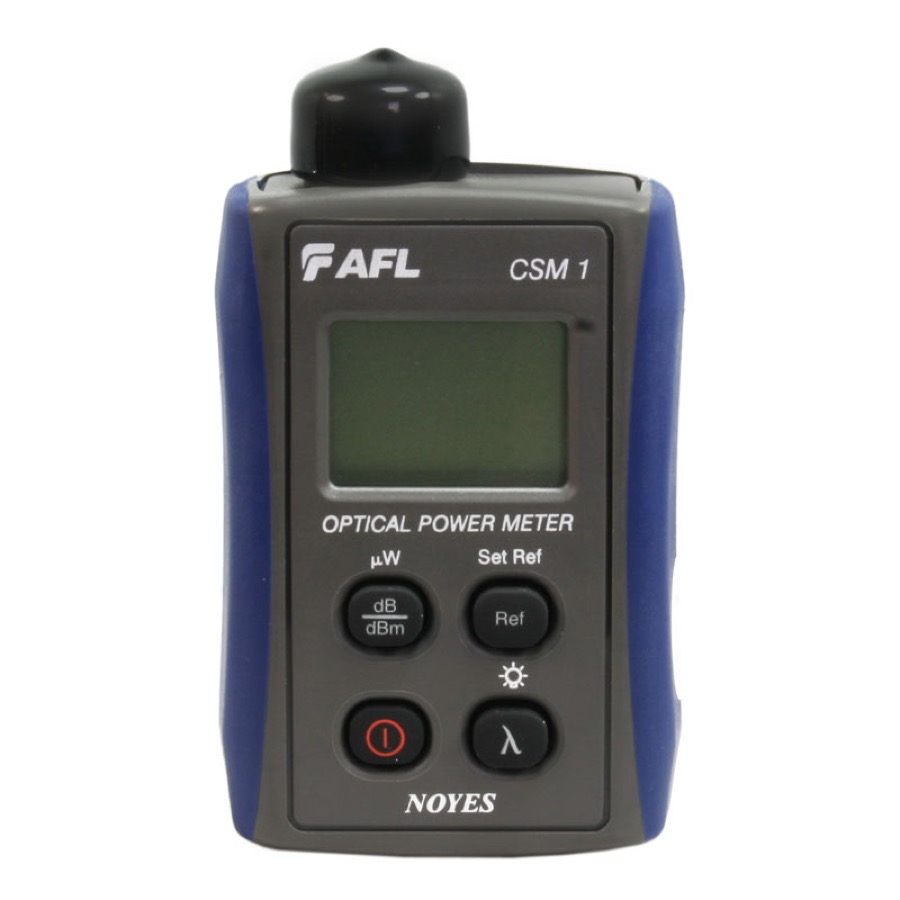
Habit no. 1 in practice: the power meter
Before you look — measure. A pocket power meter like the AFL Contractor Series CSM1 shows in a second whether there's signal in the link and at what level.
See it in the INTERLAB catalog →